
Book your 2027 departure before the end of July 2026 and Find out more
This very comprehensive Best of Africa Budget Safari ensures that you get to explore the best of Africa's game parks, wilderness areas, urban hubs and scenic highlights on one accommodated overland adventure of a lifetime!
During this trip you are likely to come across activities that encourage tourists to participate in lion, elephant or other wildlife interaction. This includes walking with lions, riding elephants and any other tourist operation putting travellers in close contact with animals that would normally live wild and separate from human contact.
We absolutely do not encourage or endorse this type of wildlife interaction operation. For more information on why this is not good for Africa's wild animals, please see our detailed blog post on the subject.


__large.jpg "Okavango delta (7)")
__large.jpg "Zanzibar beach")
Kicking off from the wonderful city of Cape Town, our Best of Africa Safari tour departs from the DoubleTree by Hilton Cape Town at 08:00 am. Please ensure you arrive at the departure point at least 30 minutes before the scheduled departure time.
Leaving the Mother City (as Cape Town is fondly called), we pause to take photos and enjoy the iconic panoramic views of the city and Table Mountain from across the bay.
From Cape Town, we drive north to the picturesque Cederberg Mountain of the Western Cape, passing quaint farmstalls en route. The Cederberg Mountains are loved by locals for the hiking trails and the endemic rooibos plants, which grow on the mountain slopes used to make a hugely popular healthy tea known as rooibos (red bush) tea.
Arriving in the Cederberg, we head to our first overnight lodge in the scenic Olifants River Valley, where we relax and enjoy a traditional dinner and a briefing on the adventure ahead.
Today our journey takes us through the Namaqualand region of South Africa, renowned for its incredibly colourful and abundant flowers during springtime (August and September). We briefly make a stop in Springbok, picking up any necessary last-minute supplies. It won't be long until this sparsely populated Northern Cape territory gives way to a fantastic view of the Gariep River, formerly referred to as the Orange River. The river serves as the border between South Africa and Namibia. We cross the river and complete border formalities before heading to our lodge which is on the Namibian bank of the river.
The evening is spent getting to know each another over a hearty meal before a comfortable night’s sleep in en-suite chalets that overlook the Gariep/Orange River. Our accommodation also offers a pool, internet, and a bar.
The Orange River was named after the ruling Dutch Royal Family, but since then it has gone back to its original KhoeKhoe name, Gariep - simply meaning “river”. This mighty river starts deep in the mountains of Lesotho and winds its way across the breadth of South Africa. What better way to appreciate this great river and its setting than joining an optional canoe ride this morning?
After lunch, we'll set course for the awe-inspiring Fish River Canyon, a natural wonder that ranks as the world's second largest canyon. We'll travel to a lookout point on the rim of the Fish River Canyon and stroll along the edge to stretch our legs and marvel at the view. We then turn west and travel to Keetmanshoop, where we will spend the night.
Day 4 of our Best of Africa adventure begins with a visit to the enchanting Quiver Tree Forest and Giants Playground near Keetmanshoop. This forest, designated as a national monument in 1995, is home to around 250 quiver trees, some of which have graced our planet for 200 to 300 years. The Quiver Trees stand tall with rough, cork-like bark and aloe type leaves which make for an iconic silhouette. Next is Giants Playground, with its peculiar piles of large dolerite boulders which make for a surreal landscape. These rock formations, dating back 160 to 180 million years, add an element of ancient history to our adventure.
Our journey continues through sparsely populated landscapes to the fabled fiery red dunes in the west, transforming landscapes showcasing the diverse faces of this desert nation. Our voyage takes us to the heart of the Namib Desert where our lodge is situated just at the edge of the Namib national park. The lodge also boasts a refreshing swimming pool and a bar, so you can unwind and take a dip to wash off the desert dust.
Today, we set off on an adventure to the heart of Namibia’s most iconic desert vistas in the Namib-Naukluft National Park. This park encompasses a significant chunk of the Namib Desert, believed to be the oldest desert on Earth.
Our journey begins at the legendary Dune 45 where you'll have the opportunity to scale this majestic sand mountain. From its peak, you'll witness jaw-dropping views of the harsh desert landscape, perfect for your travel photo collection. Next, we venture deeper into the desert via a 4x4 transfer to Sossusvlei and Deadvlei. Here, we'll trek through these arid salt pans, taking in the surreal sight of skeletal trees against the backdrop of the pale pan floors and vibrant orange dunes.
After a day filled with awe-inspiring landscapes, we retreat to our desert lodge admiring the blanket of stars and peaceful silence.
On Day 6 we start with a walking tour through the unique desert terrain around the lodge accompanied by a knowledgeable local guide who will share secrets of the ancient Namib Desert. We'll delve into the survival strategies of the San (Bushmen), unravelling the mysteries of how they have thrived in the harsh deserts of Southern Africa for centuries.
Then it's back on the road. Our journey takes us across the Tropic of Capricorn where we pause to capture this moment in a group photograph. Our next stop is Swakopmund, the thrill-seekers' paradise of Namibia, where you'll be introduced to a smorgasbord of exciting optional activities available for the following day.
We dine out at a local restaurant. Our accommodation for the night is a cozy guesthouse in Swakopmund, equipped with a bar, laundry services, and internet access.
Day 7 on this Best of Africa Overland Safari is open for you to delve into the charming town of Swakopmund, where echoes of its German colonial past can be found in its distinctive architecture, delectable cuisine, and vibrant culture.
Enjoy a leisurely walk along the sea's edge, indulge in a cup of coffee at a bustling sidewalk cafe, explore a local market, or simply soak in the sights on foot. If you're seeking a dash of adrenaline, Swakopmund doesn't disappoint! Conquer the dunes on a quad bike, glide down sandy slopes while sandboarding, experience the exhilarating rush of skydiving, or embark on a cruise for delightful dolphin spotting.
Today we journey north along Namibia’s dramatic coastline, where the arid desert meets the icy waters of the Atlantic Ocean. Our first stop is the quaint seaside town of Wlotzkasbaken—a unique photo opportunity with its surreal desert-meets-ocean setting. From here, we visit the nearby Lichen Fields, where your guide will introduce you to these fascinating, slow-growing organisms that thrive in this harsh environment.
Leaving the coast behind, we head inland toward the towering Brandberg Massif—Namibia’s highest mountain range, often glowing red in the late afternoon light and aptly nicknamed the “Burning Mountain.” This area is renowned for its ancient rock art, including the famous White Lady painting, estimated to be over 2,000 years old. We’ll embark on a ±2-hour return hike through the Tsisab Gorge, following the dry riverbed and rocky terrain to reach the site. (Please note: the hike may take place either late this afternoon or early tomorrow morning, depending on weather and conditions.)
This morning, we leave the rugged beauty of Brandberg behind and journey toward one of Africa’s premier wildlife destinations—Etosha National Park. Spanning an impressive 22,270 square kilometres (8,600 square miles), it ranks as one of Africa’s largest national parks. The name "Etosha," meaning "Great White Place" in the Ovambo language, refers to the expansive, shallow Etosha Pan located at the heart of the park. This enormous salt pan is so vast that it can be seen from space.
Get ready for thrilling wildlife encounters in one of Africa’s most iconic ecosystems. Tonight, we will stay at a comfortable safari resort near Etosha, anticipating our exciting day in Etosha National Park tomorrow.
Over the next two days, we explore Etosha National Park on game drives. We cross the open plains, scattered with acacia woodlands, and visit waterholes and the dusty fringes of the Etosha Pan. The salt pan was once a massive inland lake, but today the flat expanse stands almost entirely dry, except for the shallow waters that sometimes collect during rainy seasons. When shallow pools form in the pans, they attract large flocks of birds. Short grasses sprout after the rains, which draw in herds of grazers.
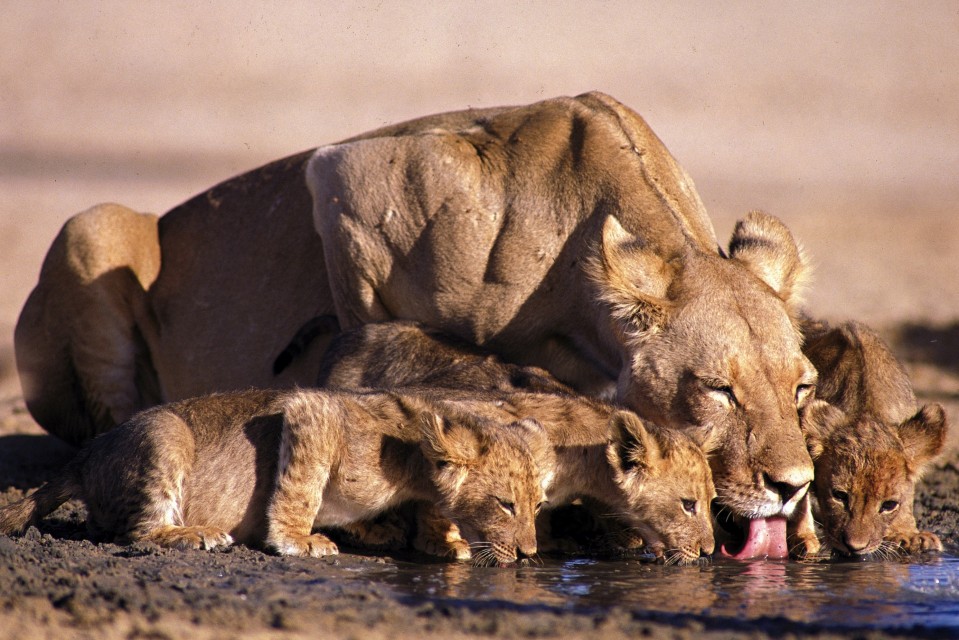
At the watering holes, wildlife watching is often particularly rewarding, given the congregation of herbivores and predators drawn to the precious water sources. Etosha is known for its dramatic wildlife sightings, not only because of the stark landscapes but also due to the intense competition that unfolds in its harsh environment, especially at the waterholes. With some luck, we are likely to encounter lions, rhinos, and leopards. Chances of sighting elephants, zebras, giraffes, gemsbok, springbok, and other antelopes are excellent.
Day 11 starts with a leisurely breakfast and an easy morning unwinding at the safari resort. After lunch, we head to our next overnight safari resort near Etosha, entering the park en route for an afternoon game drive in the overland truck.
We bid the arid landscapes of Etosha farewell and head northeast to the verdant lands surrounding the Kavango River, where waters from the Angolan highlands flow on their journey through Namibia before emptying into the Okavango Delta in neighbouring Botswana. Our destination in Divundu lies near the Kavango River, a vital life source in this region, attracting a wealth of wildlife to its shores. Its waters teem with crocodiles and hippos. For the next 2 nights, we will stay at a lodge near the Kavango River in Divundu.
Day 13 starts with a relaxing boat cruise along the peaceful Kavango River, soaking in the serene landscapes and watching for birdlife, hippos, and crocodiles along the riverbanks. In the afternoon, there’s an optional game drive in nearby Mahangu National Park—an off-the-beaten-path reserve renowned for its rich variety of wildlife, including elephants, buffalo, antelope, and the occasional big cat.
We then continue to the next exciting destination on our Africa Overland Tour - the enchanting Botswana! Crossing the border, we continue across the expansive plains of the Okavango Delta. The Okavango River has no outlet to the sea, so it empties into the sands of the Kalahari Desert, irrigating some 15,000 square kilometers of land, forming the largest inland delta in the world. This vast delta is known for its sprawling marshes, grasslands and abundant wildlife.
Our destination for the night is Maun, the gateway town for the Okavango Delta.
If you’re early enough, you have the opportunity to take an optional scenic flight over the Okavango Delta for a superb perspective on this natural wonder (weather and time permitting).
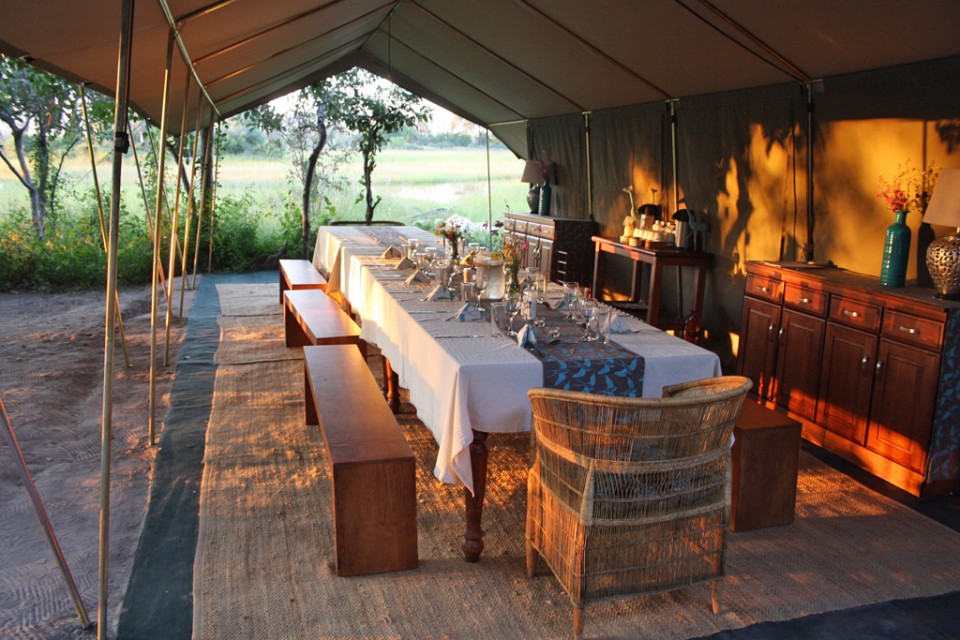
You will need to pack a smaller overnight bag for our 2-night trip into the delta due to luggage restrictions on the small game-viewing vehicles that will be required. Soon you are collected in the smaller safari vehicles for a transfer into the Khwai River Conservation Area of the Okavango Delta where we spend the next two nights.
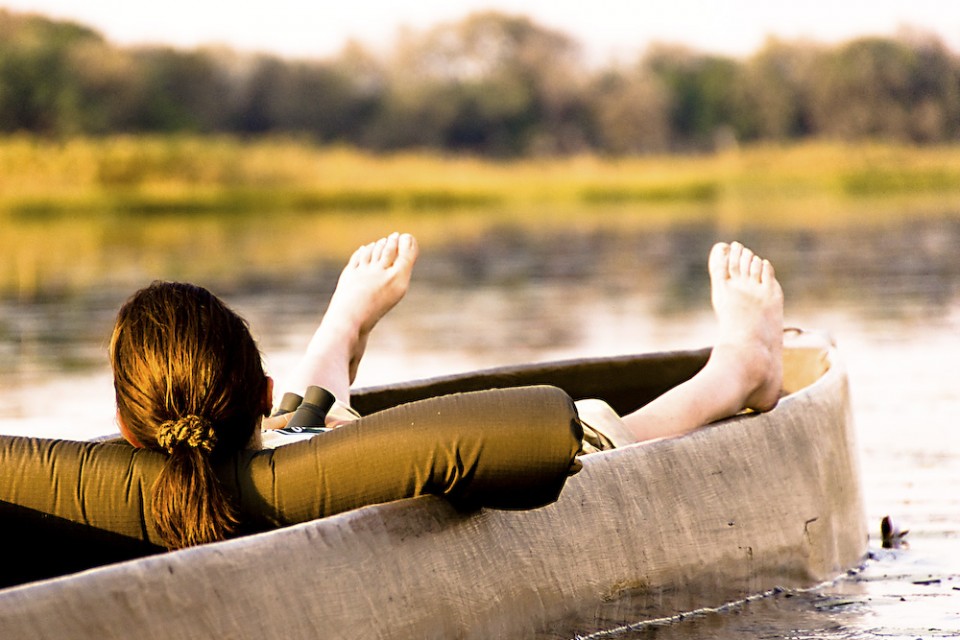
After we've made ourselves comfortable in camp, we head to a traditional mokoro polers’ station about an hour from the lodge to meet local guides who help us aboard the traditional mekoros (dug-out canoes). Your guide propels your mokoro using a long pole, navigating the waterways with ease and expertise, through the Okavango Delta’s reed-lined channels and serene lagoons adorned with lily pads. Our journey includes a stop at a secluded island, where we may disembark for a guided nature walk. Here, we encounter a rich tapestry of flora and fauna up close, offering a unique perspective to the Delta's biodiversity. The setting sun casts a magical light over the water, a perfect end to the day. Please note that the Mokoro excursion may run on an alternative day depending on the season/water levels.
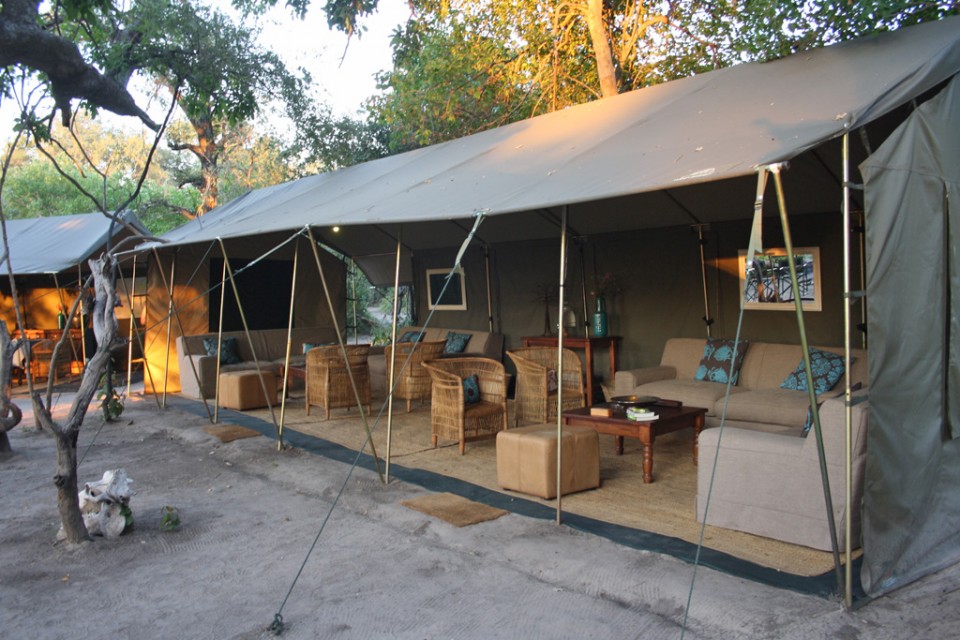
Accommodation in Khwai can best be described as a rustic-style mobile fly camp. Your meru style tent is equipped with 2 single beds and adjoining en-suite amenities consisting of a bucket shower system and chemical toilet.
On day 16 of our Budget African Safari, we embark early on a full-day game viewing in the Moremi Game Reserve, a 5,000 square kilometres area that covers a vast section of the eastern side of the Okavango Delta.. Moremi is home to the most endangered species of large mammals: the cheetah, white rhinoceros, black rhinoceros, African wild dog, and lion, amongst a host of other animals and over 500 different bird species. Our drive takes us through the diverse landscapes of the Reserve, from pans, floodplains, lagoons, grasslands, forests of acacia trees, savannahs, and dense mopane woodlands. As the sun begins its descent, painting the sky with hues of pink and orange, we make our way back to camp.
Our Best of Africa Overland Tour departs early this morning, back through the Delta landscapes to join our truck in Maun. Then, we’re on the road again, our long journey passing arid plains interrupted only by the occasional acacia tree towards the expansive Makgadikgadi Salt Pans, where the surreal scenery feels as if you've stepped onto another planet. The fascinating Makgadikgadi Pans were formed by the evaporation of an enormous ancient lake, leaving behind one of the world’s largest salt flats. It is an awe-inspiring landscape – a surreal sea of white that magically transforms into a lush, wildlife-rich oasis during the wet season. The salt pans viewpoint/pans experience is dependent on the season. We will overnight at a comfortable safari lodge in Nata.
Today we depart the pans and head towards Kasane, a vibrant town on the south bank of the Chobe River, where Botswana, Namibia, Zambia, and Zimbabwe almost intersect. We will arrive in time for lunch and have time to settle into our comfortable safari resort.
This afternoon we embark on a boat cruise along the Chobe River. From the water, we get up close to plenty of wild animals such as hippos, antelopes, buffalos, crocodiles, and elephants. Our boat-based game viewing provides excellent photographic opportunities for capturing the birds and wildlife attracted to the Chobe River in Chobe National Park. Enjoy a spectacular vista as the sun sets over the Chobe River.
It is time to say goodbye to Botswana as we embark on our next border crossing on our overland tour, into Zimbabwe. Entering Zimbabwe this morning, we drive to Victoria Falls town, home to the largest waterfall in the world.
A UNESCO World Heritage Site, Victoria Falls, is one of the most unforgettable natural spectacles in Africa - an absolute must-see! Today you have free time to visit the Falls and experience the 'Smoke that Thunders' as translated from the local name, Mosi-oa-Tunya – feel the roar of the river and stroll through the rain forest created by the resulting spray. In addition to visiting the spectacular Victoria Falls, you can jump straight into one of the thrilling adventure activities (optional extra) this afternoon or take it easy, exploring the local craft markets and coffee shops.
This evening, you can join the group for an optional dinner at a local restaurant. It’s a relaxed way to enjoy good food, unwind, and swap stories from the day. Your guide will organise the booking if you’d like to join.
Our overnight accommodation is at a comfortable lodge/guesthouse in Victoria Falls. We stay in twin rooms with en-suite bathrooms.
Most people spend the day participating in a few of the exciting adventure activities available at Victoria Falls. This part of the Zambezi River is famous for offering some of the best Whitewater rafting in the world, an unforgettable experience! Other optional adventures include helicopter and microlight flights over Vic Falls, zip-line rides, trips to Livingstone Island and bungee jumping off Victoria Falls bridge. You can also walk around the historic Victoria Falls town to take in the sights and visit the local markets, or rest at the lodge and take a dip in the pool.
Accommodation for the night is in Livingstone, on the Zambian side of the falls. A transfer from Victoria Falls village to Livingstone is included in the tour, and you may opt to take an 8 am morning or 4 pm afternoon transfer depending on the activities you choose for the day. Many of the activities take place from Livingstone. Note that a border crossing is required to get from Victoria Falls village to Livingstone.
On day 21 of this epic Best of Africa Budget Safari, we say goodbye to the natural wonder of Victoria Falls, catching a last glimpse of this natural wonder before making our way into rural Zambia. The roads too become a bit rougher, adding an element of adventure as we pass markets teeming with activity, small villages where local culture thrives, and landscapes that exude rustic charm.
We overnight just south of Zambia's capital city, Lusaka. Our Safari Camp is a shady oasis surrounded by natural bush where you may encounter animals such as impala, giraffe, zebra and fantastic birdlife!
Today we travel via Lusaka, Zambia’s bustling capital, to Petauke, the main hub for safaris to South Luangwa National Park. This long drive takes us east through lush landscapes, past small villages, crossing the Luangwa River as we head to South Luangwa. We stop at the vibrant Luangwa Market close to the bridge and spend some time browsing the stalls, sampling some of the curious local fruits and admiring the local crafts.
Early in the morning, we drive from Petauke to the border of the South Luangwa National Park, known for its outstanding game viewing. Along the way, we stop at the Mulberry Mongoose – an initiative that empowers local women to create stunning crafts using natural materials from the African bush. This project is particularly renowned for its unique jewellery line, crafted from wires recovered during conservation efforts aimed at removing poaching snares. Through this initiative, not only are these women given an opportunity to express their creativity and secure employment, but they also contribute to crucial conservation work in their area.
We spend the next two nights staying at a lodge right on the banks of the Luangwa River. Keep an eye out for hippos and other wild animals often spotted from the camp bar. We end the day with sundowners and a beautiful sunset over the river.
In the morning you have the opportunity to take an optional game drive in South Luangwa. Alternatively, you may choose to join a walking safari in the dry season (April to December). South Luangwa was one of the pioneers of African walking safaris, for which it is now famous.
In the late afternoon, we enjoy a sunset game drive in the untamed South Luangwa National Park. The park is home to an abundance of wildlife, including buffalos, zebras, leopards, elephants, hippos, giraffes and crocodiles. We stop for sundowners in the bush, before continuing our game drive into the night when we hope to spot the elusive nocturnal animals of South Luangwa.
Continuing our Best of Africa adventure we cross into Malawi, known as 'the Warm Heart of Africa'. After border formalities our route takes us through the stunning landscapes of the Nkhotakota Wildlife Reserve, a national park steeped in history and one of Malawi's oldest and most expansive nature reserves. Keep your eyes peeled for elephants and zebras wandering freely across the sprawling plains.
Our destination is the shores of Lake Malawi, the southernmost lake in the East African Rift system, where we'll be spending the next 2 nights. Recognized as one of the world's ten largest lakes, Lake Malawi stretches over 500km along Malawi's western frontier and boasts more species of fish than any other lake.
Day 26 is yours to unwind by the lake – read a book, swim, snorkel, bask in the sun, stroll along the lake shores, or explore the various attractions around. If you're up for some adventure, join an optional hike guided by a local expert to the nearby Dwanbazi Waterfall and enjoy the stunning panorama from its peak. Weather permitting, we might even get a chance to dip in the clear waters. Otherwise, embark on an optional motorboat trip, do some bird watching, or visit the nearby forest reserve. Lake Malawi is known for its friendly locals and fresh fish, in addition to the excellent water activities at this scenic lake.
Day 27 of our Best of Africa Safari takes us a little further north along the shores of Lake Malawi to our base for the night.
Your guide takes you on a walking trip to a local village where you can appreciate how rural Malawians live and meet some of these friendly locals. By late afternoon we arrive at the lakeside lodge where you can recline in a hammock and watch the sun go down over the lake with a cold drink in hand.
This morning we say goodbye to lovely Lake Malawi and travel north into our next African country, Tanzania. We cross into Southern Tanzania and head towards the Mbeya Mountain range, an arc of volcanic mountains just north of the town of Mbeya. The overnight stay on our Africa Overland Safari tonight is at a scenic lodge set on a coffee plantation lying on the mountain slopes.
Kick-start the day with some freshly brewed local coffee as we pay a visit to a local coffee plantation to sample these delicious beans and see how the coffee is grown and harvested. Learn why this region is renowned for growing coffee, due to the warm summers, fresh winters and seasonal rains.
Our journey continues with a scenic drive through breathtaking mountain passes, ascending the Great Rift Valley and passing through the verdant tea plantations of the Tanzanian Highlands.
We continue our Africa Overland Safari with a quick stop at the Baobab Valley, Tanzania. This is a truly unique landscape, dotted with towering ancient baobab trees with their distinctive silhouettes. These iconic trees create a surreal backdrop for a group picture.
Then back on the truck headed for Mikumi National Park, fourth largest park in Tanzania and part of a 75 000 square kilometre protected wilderness taking up much of southern Tanzania. Often referred to as the 'little Serengeti' for its large plains filled with giant herds of buffalo and other herbivores, Mikumi National Park is rich in diverse wildlife, hosting a large number of big game species. The park is home to animals such as buffalo, wildebeest, zebra, lion, elephant, impala, hippos, and baboons, offering visitors a chance to experience Africa's unique wildlife up close.
We stay at a comfortable safari camp for two nights. You are free to relax by the pool or book some optional activities like Mikumi Safari game drives or a choice of cultural tours.
Our epic Best of Africa Budget Overland Tour journeys out of the cool highland region of Tanzania and down to the balmy Indian Ocean. We traverse stunning landscapes of the Tanzanian countryside, dotted with quaint villages and lush greenery, headed to the bustling city of Dar es Salaam, a vibrant metropolis.
Dar es Salaam is a vibrant fusion of cultures and traditions. This evening you are free to explore the city, dine out at one of the city's restaurants and soak in the enchanting ambiance of the city by night. Tomorrow, an early start is on the cards as we need to catch the ferry to Zanzibar Island.
We make an early start to catch the ferry boat for the 2-hour ride to Zanzibar Island. Stepping foot in the main town, Stone Town, you're immediately enveloped by the city's rich history as a major port on the slave and spice trade routes. It is an intriguing place with a labyrinth of narrow alleyways, ornately carved wooden doors, and the aroma of exotic spices wafting from bustling local markets.
Arriving in Stone Town, we transfer to our hotel in the heart of town. For the rest of the day you are free to explore this fascinating place. A popular evening attraction is the food market which offers all sorts of local delicacies.
We kick off our morning with a walking tour of Stone Town, visiting famous landmarks, including the birthplace of the legendary Freddy Mercury.
Later we head out of town, stopping at a village for a guided spice tour. We stroll through the local village and visit the lush spice plantations that surround it. Here, you'll get to observe spice farm workers deftly climbing trees and identifying particular plants to pick and have the chance to buy fresh spices directly from the source.
We continue to our beach resort that will be home for the next 2 nights. This is your time to relax and enjoy the stunning seaside setting. There are many attractions and activities on offer, whether it's getting your adrenaline pumping with water sports, taking a tradition dhow sailing trip or exploring the spice island further, there's something for everyone. If you prefer, simply unwind on the beach, soaking up the warm sun and swimming in the crystal-clear waters while island life unfolds around you.
It’s time to leave the beach, as we catch a morning ferry ride back to Dar es Salaam. We re-join the safari truck and set off northward to the historic town of Bagamoyo, where we'll be spending the night.
Bagamoyo, established in the late 1700s, serves as a window into Tanzania's past, especially the 19th century, when it was a busy trading hub for ivory and slaves. Bagamoyo means to "lay down your heart," a poignant reminder. But the town is also known for its skills in the construction of traditional dhow sailing boats which still ply the waters of the old spice trade route today.
Leaving the coastal lowlands of Bagamoyo behind, we journey inland as the landscape transforms into rolling highlands, dotted with lively towns, remote villages, and sweeping savannahs. Along the way, we take in the everyday rhythms of rural Tanzanian life and the unspoiled beauty of the countryside. If time allows, this afternoon, consider joining an optional excursion to a local coffee plantation or enjoy a guided cycling tour through the surrounding area.
Leaving Moshi, we drive to Karatu, in the Ngorongoro Highlands area. This busy small town lies between Lake Manyara and the Ngorongoro Crater serving as our base for exploring the Northern Safari Circuit.
We make a stopover at the village of Mto wa Mbu known for its great tribal diversity. A visit to Mto wa Mbu Market offers a colourful slice of local life. Meander through the maze of stalls where vendors sell all sorts of fresh produce, traditional Tanzanian textiles, and intricate handmade crafts. The market also presents an opportunity to taste local delicacies and interact with the friendly locals.
On arrival in Karatu, your guide will tell you more about the 2-night trip to the renowned Ngorongoro Crater, planned for the following day.
Rise early this morning for an action-packed day in the Ngorongoro Crater. You are collected from the camp in 4x4 game viewing vehicles to descend into Ngorongoro Crater, the world's largest intact volcanic caldera, formed about three million years ago when a gigantic volcano collapsed. It is now home to over 30,000 animals due to its diverse ecosystem that boasts grasslands, forests, and lakes, making it a prime location for game viewing.
After a memorable day of wildlife viewing in the Crater, we head into the sprawling Serengeti National Park nearby where we will spend the night in the Seronera area, in a tented safari camp with excellent views over the Seronera landscape.
Day 40 is set aside for exploring Serengeti National Park, Tanzania's leading national park. The Seronera Region is famous for its outstanding predator sightings, earning it the title of the 'Big cat capital of Africa'. Sit back and soak up the iconic African safari landscapes of the vast Serengeti Plains teeming with giant herds and an impressive variety of fascinating wildlife.
We return to the truck and make a return journey to Arusha, admiring the scenic Great Rift Valley en route. This evening we relax at a comfortable lodge and recount our incredible wildlife adventures on Tanzania's Northern Safari Circuit.
We travel north today crossing the border into Kenya. We continue to the capital city, Nairobi, where we'll be spending the night. On arrival, you have the afternoon at your disposal. Take some time to explore the vibrant city life, visit the Nairobi National Park for a mini safari, appreciate art at the Nairobi Gallery, or shop for unique crafts at the Maasai Market. Taste local cuisine at the city's numerous eateries.
You will need to prepare a small overnight bag for the trip to the legendary Masai Mara National Reserve. Tomorrow we will transfer to smaller 4x4 safari vehicles which have less luggage capacity.
We are collected in safari vehicles and set off from Nairobi, headed southwest to the iconic Masai Mara Game Reserve, the backdrop for many a wildlife documentary and the epitome of the African safari experience. As we journey into the Great Rift Valley, we pass rural villages that are home to members of the Maasai tribe famed for their vibrant robes, formidable warriors, and traditional dancing.
The Masai Mara Reserve lies alongside the Kenya-Tanzania border, connected to Tanzania's Serengeti. It is between these two areas that the annual migration takes place. We devote the next 2 days to game viewing in the vast, unspoiled savannah landscapes of the Masai Mara. The rolling grasslands teeming with high concentrations of wildlife provide superb photographic opportunities and animal sightings. Keep an eye out for the Big 5 – lion, leopard, rhino, elephant, and buffalo – and a host of other animals like cheetahs, hyenas, giraffes, and zebras.
We stay at a tented safari camp located right next to the Sekanani gate of Masai Mara.
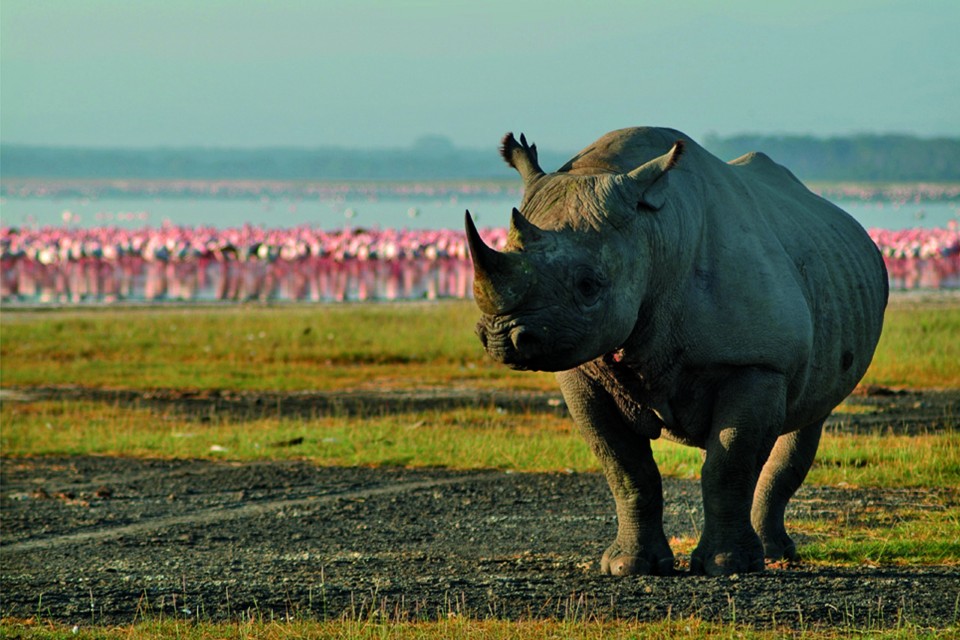
Today we set off north from Masai Mara towards Lake Nakuru National Park. This 180 square kilometer game park boasts impressive numbers of endangered white and black rhinos, and you can also hope to spot anything from lion and cheetah to herds of buffalo, Rothschild giraffe, eland, waterbuck, resident hippos, and even large tree pythons. Originally established as a bird sanctuary, this Park is home to a wide array of birds, with over 400 resident species as well as various migratory birds.
Lake Nakuru is a small lake created by the Great Rift Valley. The lake's alkaline waters provide an ideal environment for the growth of blue-green algae that flamingos feed on and, at certain times of the year, visitors are treated to the sight of thousands of pink flamingos who flock to the lake to feed in the shallows. The park has many scenic viewpoints to capture this beautiful spectacle (seasonal).
We overnight at a lodge in the centre of Nakuru town.
On Day 46 of our Best of Africa Safari we re-join the truck and cross into our next country, Uganda, known as “The Pearl of Africa”. We also make another significant crossing today: we will cross the equator en-route, so there will be time to make a stop for a photo opportunity before we continue.
We are headed to Jinja, a vibrant city on the northern shores of Lake Victoria, recognized globally as the source of the Nile River. From this point, Africa’s greatest river flows 6,695 kilometers (over 4,100 miles) north to Egypt and the Mediterranean Sea. We will overnight at a tented camp close to the Nile riverbanks and the Kalagala Central Forest Reserves.
Jinja is also known as epicentre of adventure, and there is a range of adrenaline experiences, from white-water rafting world class rapids to bungee jumping, kayaking and a host of other land and river-based activities on offer.
Our journey continues, along the northern shores of Lake Victoria. We make a brief visit to Kampala, capital city of Uganda located on a series of hills above the Lake. From there we continue, heading northwest towards Lake Albert, another of the Great Rift Valley lakes.
Our stop for the night is Masindi, known as the gateway to Murchison Falls National Park, one of Uganda's oldest national parks. The park covers some 3 840 square kilometers of wilderness in the Albertine Rift Valley, part of the western section of Africa's Great Rift Valley. The Victoria Nile River runs through the park, plummeting through a narrow gorge to form the spectacular Murchison Falls, after which the park is named.
Later, we head to the Ziwa Rhino Sanctuary, where there is an option to take a bush walk in search of highly endangered rhinos. This 7,000-hectare sanctuary is part of the rhino conservation program run by a non-profit called Rhino Fund Uganda (RFU). Rhinos are bred here for release back into the national parks of Uganda.
This morning we go chimpanzee trekking in the Budongo Forest Reserve close to Lake Albert. The Budongo Forest is a tropical rainforest of magnificent Mahogany trees that is home to the largest number of chimpanzees in Uganda. We meet our local guide who takes us on small 12-person groups to trek through the forest in search of the chimp family groups. We get to spend an hour quietly observing these intelligent creatures in their natural habitat.
Later we enjoy a cruise on the scenic Nile River as it flows through Murchison Falls National Park. The boat ride provides an excellent opportunity for game viewing along the riverbanks as the boat is able to get quite close.
Note, when there are larger safari groups, your tour group may be split for chimpanzee trekking, so the timetable today remains flexible and you may end up taking the boat cruise in the morning and chimpanzee trekking in the afternoon, and vice versa.
We depart Masindi headed southwest towards the Ruwenzori Mountain range. We are headed to our accommodation on a hilltop overlooking Lake Kikorongo, a crater lake and extension of Lake George on the edge of Queen Elizabeth National Park. The area is known for its volcanic features, craters now tranquil lakes and lush grassy basins, and a giant row of strikingly beautiful volcanic cones that offer breathtaking panoramic views and a unique habitat for an array of wildlife.
Today we head to scenic Lake Bunyonyi, crossing the equator once more. Lake Bunyonyi is one of Africa's deepest lakes and is dotted with 29 lush islands, each with their own unique tales and allure. As the name meaning 'Place of Many Little Birds' suggests, Lake Bunyonyi is a bird watchers paradise, boasting over 200 bird species. The lake is safe for swimming and is a popular spot for water activities.
We stay at a lovely resort on the shores of Lake Bunyonyi taking in the beautiful scenery and settling in as this will be our base for the next 3 nights. This evening you will be briefed on the gorilla trekking excursion taking place the following day.
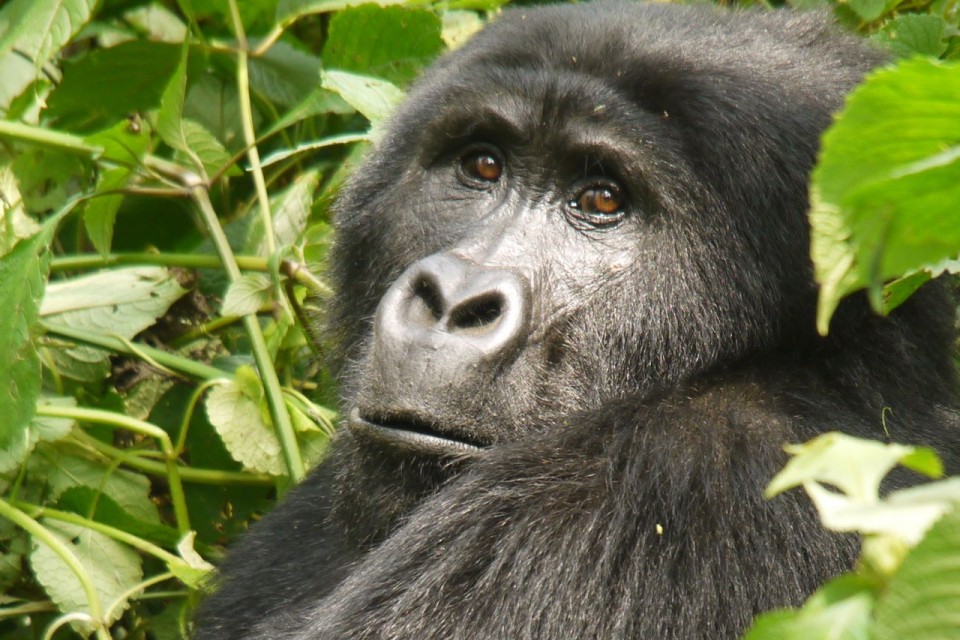
From Lake Bunyonyi we set off on our thrilling gorilla trekking expedition, in groups of a maximum of 6 people. African Mountain Gorillas are critically endangered, with only around 800 wild mountain gorillas remaining in the world. By visiting the gorillas, you will be directly supporting the efforts to protect these highly endangered primates. The money spent on trekking permits is used to help ensure the future of these rare mountain gorillas.
Gorilla Trekking permits are extremely limited, which calls for flexibility in our tour itinerary and the exact location that we trek in. The mountain gorilla habitat spans the borders of Uganda, Rwanda and the DRC (The Democratic Republic of the Congo). If permits for the Uganda Park are not available, you will be informed beforehand, and we will travel to neighbouring Rwanda or the DRC for mountain gorilla trekking.
On the day that you don't go gorilla trekking, you have the chance to go hiking or mountain biking to explore the scenic area around Lake Bunyoni.
Please Note: The Gorilla Trekking permit is not included in the tour price. Only one day is spent trekking the gorillas, even though there are 2 days set aside. This allows time for obtaining permits and visiting the gorillas in smaller groups if there are more than 6 people on the tour.
On day 53 of this Best of Africa Overland Safari, we leave the peaceful shores of Lake Bunyonyi and head for the next lake of our tour – Lake Mburo. The lake is part of the Lake Mburo National Park, smallest of Uganda's savannah national parks that, despite its size, boasts an impressive variety of landscapes, from savannahs and forests to wetlands and hills. Its waters are home to crocodiles and hippos, while its shores attract buffalos, zebras, and over 350 bird species, including the rare African finfoot and shoebill stork.
Our accommodation for the night is a tented camp just on the border of Lake Mburo National Park.
In the morning we head northeast, back to Uganda’s adventure capital, Jinja, where we will spend the next 2 nights.
The time is yours to unwind at the resort on the banks of the Nile River or embark on some of the many optional adventure activities on offer, including quad biking, horse riding, kayaking and river cruises. The most popular activity in Jinja is white water rafting, which is available as a half-day activity.
Today we say goodbye to beautiful Uganda and make our way across the border, back into Kenya. Our stopover for the night is the city of Eldoret in the heart of the Great Rift Valley. Established as a post office on a local farm in 1910, today Eldoret is the 5th largest city in Kenya. Called the 'City of Champions', it lies 2,100 m above sea level, attracting world renowned runners who seek out the high-altitude for athletics training at the High-Altitude Training Centre.
On the last day of our Best of Africa Safari, we drive southeast to Nairobi, where the journey of a lifetime comes to an end.
Most groups choose to meet for an optional dinner to share stories and exchange contact details with fellow travellers.
Note: The Itinerary is flexible and can be changed without notice to accommodate the best possible viewing of the Mountain Gorillas. The Permit price to visit the Gorillas can also change without notice.
This Best of Africa Lodge Overland Tour from Cape Town to Nairobi is also available in the opposite direction as the Best of Africa Safari (South) from Nairobi to Cape Town. For more details contact African Budget Safaris
It is important to remember that the Wildebeest Great Migration is seasonal. Its timing and occurrences are unpredictable, so witnessing this great spectacle cannot be guaranteed.
The journey of the wildebeest, accompanied by great herds of other herbivores, spans across the expansive plains of Masai Mara in Kenya and Serengeti in Tanzania. This grand procession follows an impressive circular route stretching over 1200 miles (1931km), creating a constant ebb and flow of wildlife that can be observed in different areas throughout the year.
At different stages of this annual pilgrimage, the pace and concentration of the herds fluctuate. There are times when they disperse, while at other times they are on the move, resulting in larger, denser congregations of animals. The Wildebeest Great Migration is not a fixed event; it varies from location to location, season to season, and even year to year.
Please talk to a travel expert from African Budget Safaris about seeing the Wildebeest Great Migration on your safari to find out more. Also, check out our detailed article about the Great Migration in Serengeti and Masai Mara.
For up-to-date and confirmed pricing info for optional items, please drop us an enquiry.
This tour does take children.
There is a minimum age limit of 12 years of age, for travellers on scheduled departure dates.
A maximum of 4 children, aged between 12 - 15 years, will be allowed on any scheduled tour departure date.
Should there already be 4 children confirmed on a tour, any further children requests will be dealt with on a request basis only.
There is a minimum age limit of 16 years or older, to partake in the Gorilla and Chimpanzee trekking and Pygmy Village visit.
Age restrictions may apply to certain items listed in the respective tour activities and it is important that you are aware of these restrictions prior to confirming children on tour.
Please contact African Budget Safaris for further information.
All Cape Town Departures |
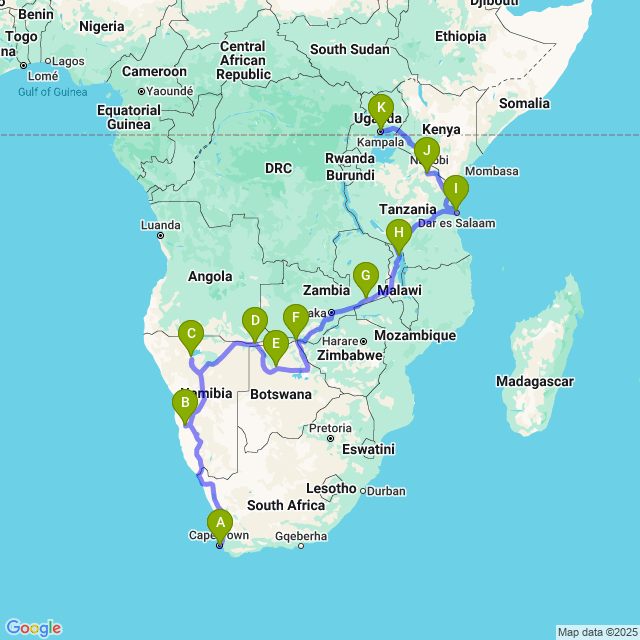

The best Budget African Safari: an epic Africa Overland Tour of Kenya, Uganda, Tanzania, Zanzibar, Malawi, Zambia, Zimbabwe, Botswana, Namibia & South Africa

An Overland Camping Safari to 9 countries! This Overland Africa Tour of a lifetime explores game parks, beaches, deltas and forests, from Cape Town to Nairobi.
Travel from Cape Town to Johannesburg on a 31-day Southern Africa lodge overland tour through South Africa, Namibia, Botswana and Zimbabwe, including Etosha, Okavango Delta, Chobe, Victoria Falls and Kruger.

The ultimate Overland Adventure Safari in Southern Africa: a small group tour from Cape Town to Johannesburg via Namibia, Botswana, and Zimbabwe, including a desert tour, delta tour and Victoria Falls.

Lodge Cape Town to Namibia Safari: Africa Overland Tour to Namaqualand, Orange River, Fish River Canyon, Namib Desert, Swakopmund, Brandberg, Etosha & Windhoek
From Cape Town see wildlife in Namibia’s Etosha, Botswana Okavango Delta & wild South Luangwa Zambia, mighty Victoria Falls, Lake Malawi, Great Rift Valley into Tanzania, idyllic Zanzibar, ending Dar-es-Salaam.
__small.jpg)
Travel from Cape Town to Victoria Falls on a 20-day overland lodge safari through Namibia and Botswana. Explore the Namib Desert, Etosha, Okavango Delta, Chobe and Victoria Falls.
Our team has the destination knowledge to help you plan an unforgettable African adventure. We're based in Cape Town and ready to help.
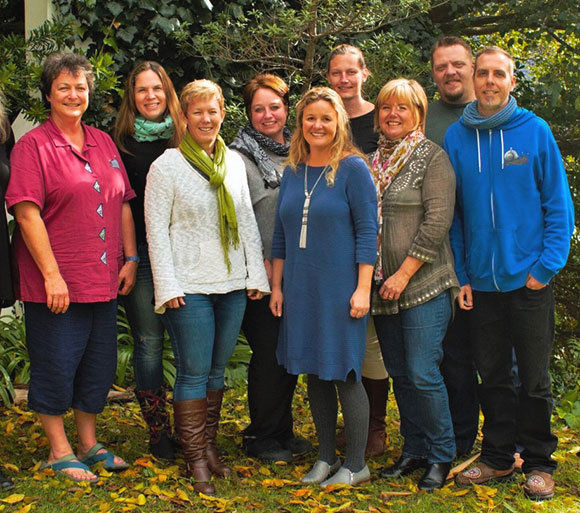
We can also plan you an affordable private group or tailor-made tour. We built our business on turning luxury travel into affordable travel.