Whether you’re a hard-core birdwatcher or just enjoy seeing and hearing them, southern Africa is a birdwatcher’s paradise. It is home to just under 1000 bird species, of which about 70 are endemic or near-endemic African birds.
From the tiny sunbird to the huge, comedic-looking ostrich, and everything in between, birders will surely tick off some of their must-sees!
And for those who aren’t such enthusiastic birdwatchers? After hearing the magnificent cry of a fish eagle, seeing the pink plumage of the flamingo, or just sitting in the bush listening to the wide range of twitterings, we’re pretty sure you’ll go home a birdwatcher!

The ballerina of African birds, these beautiful, long-legged, pink-plumed fowls hang out in large flocks, creating wild pink scenes in wetlands. You may recognise them from the plastic versions that populate many lawns. The real thing is far more spectacular.
With their long necks, which are very flexible due to their having many vertebrae, they filter feed, extracting food from the water before expelling it again.
While flamingos are found in wetlands in many areas of southern and eastern Africa, their breeding grounds (to which they migrate) are very small. During the breeding season, they flock to Etosha Pan in Namibia, Sua Pan in Botswana, Kamfers Dam in South Africa and Lake Natron in Tanzania.

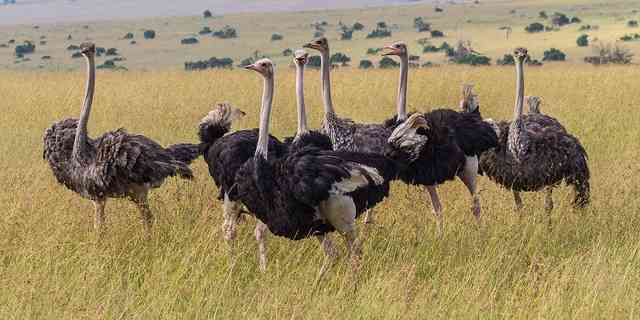
Contrary to popular folklore, ostriches don’t bury their heads in the sand. The fact they’re the largest living birds, is true though, some reaching up to 2.8 m tall and weighing up to 150 kg!
It’s no surprise, therefore, that they are flightless. Don’t challenge an ostrich to a running race - they can run at 50 km/hour, and do short sprints of 70 km/hour!
Ostriches are funny-looking creatures, with their round bodies and beautiful feathers (black for males, grey for females) that they can puff out like puffer fish, long necks and legs with two-toed feet. It’s hard not to be charmed by their incredibly long eyelashes.
While ostriches are farmed extensively, they are also seen in the wild across most of southern Africa, especially in the more arid areas like the Karoo National Park, and the Kgalagadi Transfrontier Park.

Another biggie, the Secretary Bird is an African bird of prey that reaches up to 1.3 m tall. It has distinctive black head feathers that make it look a little like it’s wearing a Native American headdress. With a body like an eagle, legs like a crane, and a hooked bill, it’s almost as comedic as the ostrich. And then there are its trendy black knickerbockers...
The Secretary Bird, however, flies, but only if it really has to. Unlike other birds of prey, it does most of its hunting on foot, sometimes in pairs, other times in a flock. They, basically, stomp their prey out of hiding on the grasslands. They can quite easily stomp a snake to death - formidable indeed.
It is found throughout sub-Saharan Africa, mainly in grassy plain/savannah areas. They are seen prolifically in the Lower Sabie and Satara regions of the Greater Kruger National Park.

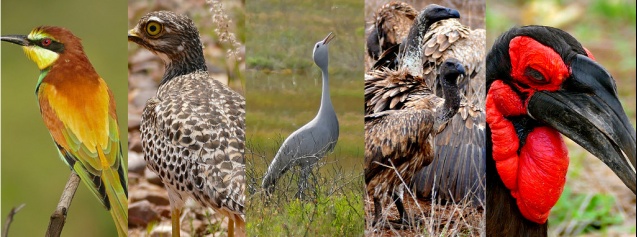
Weighing in at just 34 to 59 grams, these brightly coloured little African birds are a treat to behold. With their carmine bodies and bright blue heads and under-tails, they generally hang out in large flocks, providing an amazing spectacle.
They nest in the mud banks of rivers and follow a migratory route, moving three times each year. These little jewels of the sky spend their time between Zimbabwe/Zambia/Namibia (August to November), northern South Africa (December to March) and equatorial Africa (March to August).
Plan your safari carefully to sneak a peek at these beauties as they hunt flying insects in flurries of colour. Visit places like The Hide at Hwange or Chobe in October to watch this spectacular display during mating season. Even better, see it from a boat, like the Zambezi Voyager.

Endemic to South Africa, and its national bird, these feathered friends are critically endangered. They are tall and willowy, with blue-grey feathers and wings that end in long, dark grey feathers that hang to the ground like a shawl.
They are beautiful African birds found commonly in pairs or small familial flocks. Breeding happens from October and their mating ritual includes running around each other in circles, jumping and flinging objects in the air. It is a special sight to see.
The Blue Crane Route through the Eastern Cape is filled with these blue wonders, as is the Overberg region, near Cape Town.

The call of the Fish Eagle is a sound that’ll make any African homesick.
These majestic African birds are found throughout most of sub-Saharan Africa. They hang out near water – rivers and lakes – and are expert fishermen.
With their distinctive white head, chest and tail, brown body and black wings, they ooze power. In flight, their wingspan can reach 2.4 m as they swoop over rivers and grab fish in their powerful talons.
Goukamma Nature Reserve on the beautiful Garden Route and Parfuri River Camp on the banks of the Luvuvhu River in northern Kruger National Park are just two places to spot Fish Eagles.

Another pretty African bird, this one is highly distinctive. Hoopoes – named onomatopoeically, due to their call – have orange chests, black and white striped wings, long thin beaks and a conspicuous crest made up of orange and black feathers.
When it raises its crest, it is the bird version of a Mohawk.
Hoopoes are found in areas throughout southern Africa and into Tanzania and southern Kenya.

While we realise it’s rude to call someone ugly, these African birds are not overly beautiful, but we're sure their mothers love them. This is part of their appeal. They are large birds, reaching a height of up to 1.3 m and weighing up to 6 kg.
The thing about the ground hornbill is their distinctive red wattle, or bare red skin, around the face and throat. When they call, their wattle inflates and they make a deep sound which has been compared to that of a lion, earning them the nickname of ‘thunder birds.’
Sadly, they too are highly endangered, with an estimated population in South Africa of only 1500, half of which are found in the greater Kruger National Park. Visit Sabi Sabi to see these beautifully ugly creatures.

The most common owl in southern Africa, these nocturnal birds can be seen sleeping in trees during the day. They are distinguished by their spotted plumage and feather tufts on their heads that look like horns or ears.
At sunset, they swoop silently away for a night of hunting small rodents. Their call is gentle and beautiful and they are completely silent when they fly.
Spotted eagle owls are regularly spotted (see what we did there?) at Berg-en-Dal and five Lebombo Lodge in the Kruger National Park and if you know where to look, you may see the resident owl up in a tree at Kirstenbosch Gardens in Cape Town.
To find out more about seeing African birds on your safari, talk to a safari expert at African Budget Safaris.

Explore these destinations mentioned in this post.
Below you'll find further reading and articles related or similar to this post.




Call us toll free from US/Canada on 1-888-414-6513, or from the UK on 0-808-189-1052. All other countries can contact us on +27 21 791 0878.
© 2026 African Budget Safaris | Privacy | Terms | Cookie Policy | Consent Preferences


_(1)__thumb.jpg)


__medium.jpg)