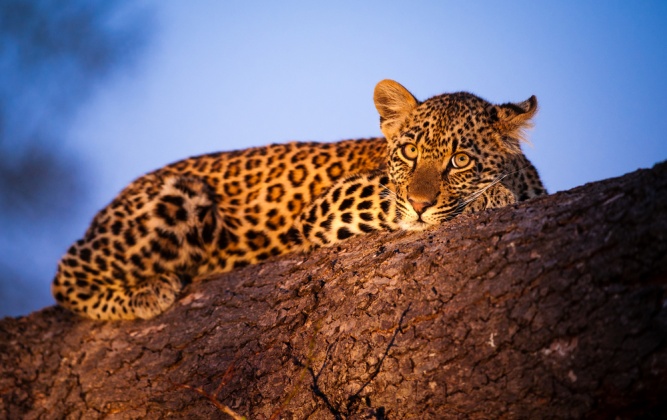
The first word that comes up when talking about leopards is 'elusive'. This is because they are generally solitary, and prefer to hang out in dense bush (and have fantastic ‘dense bush camouflage’) or up trees. These African big cats are mostly nocturnal, making the chances of spotting a leopard very low. Bottom line: if you get to see one of these beautiful animals in the wild, you’re very (very!) lucky.

In this blog post, we’ll answer the most commonly asked questions about leopards, one of our favourite African big cats. We also cover some of our favourite safari destinations where you might get to spot a leopard and give some hints on how to increase your chances of seeing a leopard on your African safari.
Leopards are the second biggest wild cat, beaten only by the lion. Unlike lions, and contributing to their elusiveness, leopards are mainly silent. They are, arguably, the most beautiful wild cats, with their spotted, velvet-like fur, elongated body and graceful stride. They’re also incredibly strong and can carry animals heavier than themselves, often dragging them up trees.
Leopards hunt mainly at night, their prey most often antelope. They are stalkers, rather than chasers and lose interest quickly if their prey escapes after a short charge of up to 60 km/hour. When they catch their prey, they deliver a fatal bite to the neck or strangle it by holding it by the neck, before dragging it, often up a tree, and feeding off it over a few days.

It is thought that a single leopard will eat about 400 kg of meat per year, killing about 20 animals to get that.
As we mentioned above, leopards are generally solitary – each one occupying about one square kilometre (0.4 square miles) in the Kruger National Park – and only come together for a brief period, to mate. Mating occurs at any time during the year and the gestation period is about 100 days.

Litters range between two to four cubs, with only around half of them surviving their first year. Cubs remain with the mother until they are about 18 months to two years old and, even after ‘leaving home’, mothers and their ‘grown-up’ cubs have been known to share kills.
Yes, leopard cubs are born with blue eyes, which change to green-gold as they grow up. In fact, they’re born with their eyes closed, and they only open about ten days after birth, revealing their blue peepers.

Also, they’re born without their spots … these develop as they grow.
There is only one species of leopard, which is divided into nine sub-species, one of which is found throughout Africa: Panthera pardus pardus. Leopards belong to the scientific family Felidae, genus Panthera, which includes lions, jaguars and tigers, species Panthera pardus.

While several different sub-species have been recognized in Africa, genetic analysis on small sample sizes showed that they are all closely related, thus the majority of references refer only to Panthera pardus pardus, or African leopards. The following sub-species have been recognized over the years:
Telling the different sub-species apart (other than using your location) is nearly impossible. The markings on each leopard are unique and colouration can be slightly different, depending on the area and habitat in which they live. For example, leopards living in forested areas tend to be darker than those living in desert conditions.
The areas inhabited by leopards are vast but, sadly, humans have done a good job of invading their habitat and hunting them. There are still wild leopards in the more rural areas, but these are seldom – if ever – seen, even by those who live there. But which safari destinations are the best to increase your chances of spotting leopards?

Many of the most loved game reserves have leopards and some of them have a better track record of sightings than others. They include reserves in all of the southern and East African countries our safaris go to. Our four top spots:

Leopards are found throughout Kruger but Sabi Sands, which forms part of the Greater Kruger National Park, is renowned for its leopard sightings, with perhaps the highest concentration of leopards worldwide in the area. This means the likelihood of spotting a leopard is much greater in the area.
Some of African Budget Safari trips include Kruger and Sabi Sands:
Scroll through our Sabi Sands Safaris to find the one that's best for you.
Head to the parts of Moremi that border the Okavango Delta, where leopards have easy access to water and can hide out in the dense woodlands.

Add on to your trip and experience the beauty of the waterways of the Okavango. Some of the African Budget Safaris trips that include Moremi and Okavango:
With one of the highest populations of leopards, South Luangwa – relatively speaking – the uncrowded game reserve is the perfect place to go in search of these magnificent creatures.

While you’re at it, you’ll get to experience the beauty of the area and a plethora of other African favourites like giraffes, lions and hippos. Some of African Budget Safaris' trips that include South Luangwa:
These reserves, which join, unfenced at the border between Kenya (Masai Mara) and Tanzania (Serengeti) have both resident and migratory leopards.

This is the land of Africa’s ‘greatest show on earth,’ the Great Migration, where, annually, millions of wildebeest, antelope, zebra, and the predators that eat them follow a circular route through the parks in search of grazing. See our blog about the Great Wildebeest Migration and get a booking! Some of our African Budget Safaris trips you can choose from that include Serengeti and Mara are:
You name your favourite African animal, you can see it. All of the game parks listed above are home to the Big 5 animals, many species of antelope, giraffe, zebra, hippos and crocs, to name a few.
It is impossible to say exactly how many are left, because they are so, very, shy, making counting them impossible. According to the International Union for the Conservation of Nature's Red List of endangered species, leopards are classified as "vulnerable" to extinction.

In an interview with Samual Williams, a conservation biologist from Durham University who is involved in studying the leopards of the Soutpansberg, he estimated in 2017 that there are 4,500, at best, leopards left in South Africa.
Remember, leopards are elusive - they’re solitary, they’re shy, they’re nocturnal and they’ve got excellent camouflage, which blends in with wherever they’re lurking. All of which makes leopards difficult to see in the wild.

A couple of tips for increasing your chances of spotting a leopard:
Another top tip is not to confuse leopards with cheetahs, an easy mistake for new safari-goers. See how to tell the difference in Cheetah vs Leopard: What's the difference?

The bottom line is seeing an African leopard in the wild is an incredible experience. Contact one of our knowledgeable travel consultants and book your big cat safari now.

Explore these destinations mentioned in this post.
Below you'll find further reading and articles related or similar to this post.




Call us toll free from US/Canada on 1-888-414-6513, or from the UK on 0-808-189-1052. All other countries can contact us on +27 21 791 0878.
© 2026 African Budget Safaris | Privacy | Terms | Cookie Policy | Consent Preferences




tours_through_moremi_game_reserve__thumb.jpg)