It's a question we get asked a lot.
Kruger National Park (KNP) is the core section of the protected area managed by South African National Parks (SANParks), covering over 19,000 km² and featuring regulated entry, roads, and public accommodations. The Greater Kruger National Park (GKNP) refers to the more than 20 private reserves west of Kruger National Park (KNP), which add 180,000 hectares to the reserve.
These privately owned concessions include Sabi Sands, Timbavati, and Balule. Together, Kruger and Greater Kruger National Park form an unfenced wild reserve with free movement of animals across this spectacular land.
The private reserves of the Greater Kruger ecosystem stretch along the unfenced western boundary of Kruger National Park, forming a continuous wildlife landscape where animals can roam freely between the national park and the surrounding private reserves.
This Greater Kruger National Park map shows the location of the main Greater Kruger private reserves in relation to the Kruger National Park entrance gates and the regional airports.
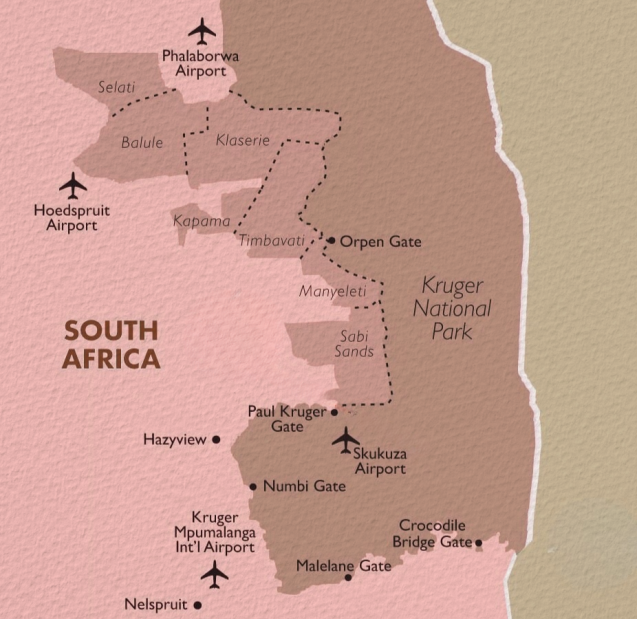
The position of these reserves along Kruger’s boundary directly affects the safari experience:
In total, the Greater Kruger National Park adds 180,000 hectares to the Greater Kruger ecosystem.
Here is a breakdown of the main Greater Kruger private reserves, ranked by size:
| Private Reserve | Size (Hectares) | Comparison |
| Sabi Sand Game Reserve | ~65,000 ha | Roughly the size of the Isle of Man, or half the size of Los Angeles |
| Klaserie Private Nature Reserve | ~60,000 ha | About the size of Greater Manchester, or the city of Chicago |
| Timbavati Private Nature Reserve | ~53,000 ha | Slightly larger than the city of Glasgow |
| Balule Private Nature Reserve | ~40,000 ha | Similar in size to the Isle of Wight or the city of Las Vegas |
| Manyeleti Game Reserve | ~23,000 ha | Comparable to the Birmingham city area, or twice the size of San Francisco |
| Kapama Private Game Reserve | ~13,000 ha | Similar to the city of Cambridge and surrounds, or slightly smaller than San Francisco |
| Thornybush Game Reserve | ~11,500 ha | Close to Oxford’s area, or the city of Miami |
When combined with the Kruger National Park, the Greater Kruger ecosystem is roughly half the size of Switzerland, and more than twice the size of Yellowstone National Park in the USA. This makes it one of Africa's largest conservation areas.
Even though the private reserves seem small compared to the Kruger National Park, they share open borders. The wildlife moves across a range of more than 21,000 square kilometres rather than staying inside a single reserve. This supports migration patterns, high predator densities and premium Big Five sightings.
So what is the difference between the Greater Kruger Park and the Kruger National Park safari experience in South Africa?

A commonly asked question, and easily answered.
Firstly, what's the same? From a fauna and flora point-of-view: there is not much difference.
The parks are next to each other and there are no fences between them, so the animals and birds who call the area home can roam freely and are found in both. In saying that, however, the area is large, so habitats differ and of course, animals gravitate toward whichever habitat is best for them. Some areas are better known for their leopard sightings, others for elephants, etc.
The main difference between Kruger and Greater Kruger boils down to ownership and management. While Kruger National Park is government-run by SANParks, the private reserves in Greater Kruger National Park are privately owned and independently managed.
There are four main differences between the Kruger and Greater Kruger National Park of South Africa.

The parks that make up the Greater Kruger National Park are strict about visitor numbers and limit access in this way. For example, there are no day visitors allowed into Greater Kruger Park.
There is less safari accommodation available, too ensuring that visitor numbers are low.
This means that your African safari experience is far more exclusive and the focus will remain firmly on the bush and the wildlife rather than the other visitors crowding in to see a lion kill or catch that special photo of a zebra baby.
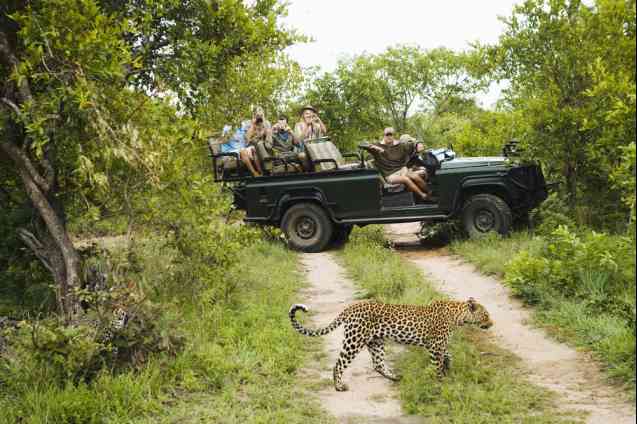
The Greater Kruger National Park offers safari visitors access to the real African safari experience.
Experienced guides take visitors not only on safari vehicles (including to off-road areas), but also on walking safaris and night drives. You can't get closer to the wild than this - sights, sounds and smells included!
On Kruger National Park safaris, game drives - whether guided or self-drive, are restricted to the extensive road network.
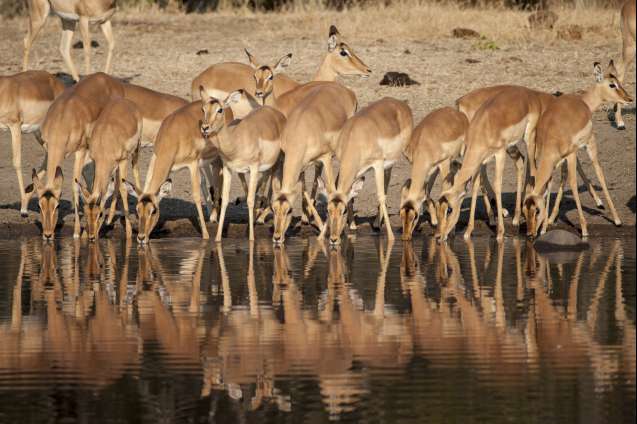
Safaris in the Greater Kruger National Park come with experienced and knowledgeable guides with superlative tracking skills. They know their wildlife concessions and the animal's habits in their areas.
This insider knowledge allows them to find the game that you are looking for, not only the big animals like the Big 5. From the smallest insect to the smaller cats and hares to birds and buck, all the way up to the enormous elephant, these rangers know their stuff.

Lodges in the Greater Kruger National Park are typically more high-end than those in Kruger National Park, offering a more private and exclusive experience due to limited guest numbers. With personalized service and attentive staff, these lodges prioritise creating the best possible safari experience.
For more about these differences see Kruger vs Greater Kruger based on a firsthand South Africa safari experience.
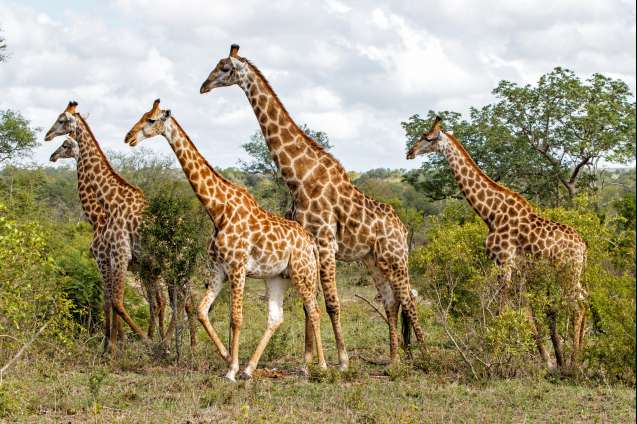
The area of the Kruger National Park was first declared a game reserve way back in 1898. First called the Government Wildlife Park, then the Sabi Game Reserve, it was finally called the Kruger National Park in 1926.
Many of the farms surrounding the Kruger National Park were also game farms, but privately owned. Over twenty of them got together and established the Associated Private Nature Reserves, a non-profit organization to uphold the principles and values of conservation, sustainable land use, and local community development. In the early '90s, the Kruger National Park and Associated Private Nature Reserves dropped their fences (after ensuring the outer borders were adequately fenced), effectively adding 180,000 hectares of land.
This addition to the park increases grazing area for the animals, extends their potential gene pool and - for us - increases the chances of sighting all of the wildlife we go on safari to see!
The Greater Kruger National Park of South Africa includes Timbavati, Makuya, Letaba, Balule, Klaserie, Umbabat, Manyeleti and Sabi Sands Game Reserves.
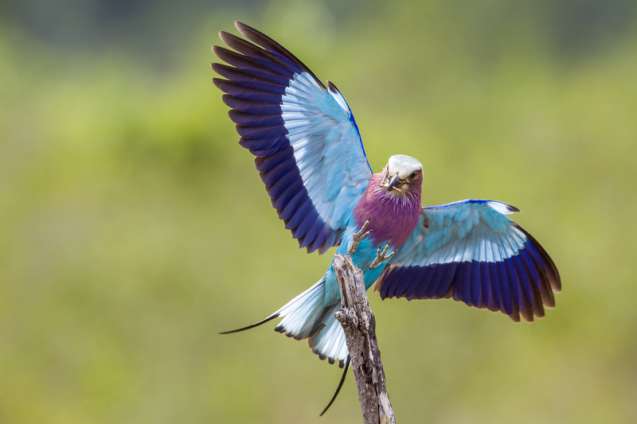
The Greater Kruger National Park in South Africa comprises over twenty game parks, many divided into smaller parks. There are no fences between any of them and each one offers spectacular scenery and a chance to see not only the Big Five but a huge array of other wild animals and birds!
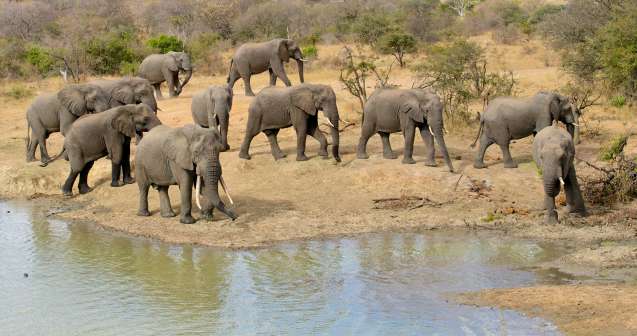
Balule Private Game Reserve consists of 40,000 hectares of prime game reserve. Balule Game Reserve is home not only to the much sought-after Big Five but also to an incredible variety of other wildlife – antelope, big cats, wild dogs, giraffes, zebra, to name a few – and birdlife. With the perennial Olifants River flowing through it, Balule is a prime game- and bird-watching area.
Our 6-day small group Kruger and private reserve safari explores Balule over two full days, including sunset game drives, a guided bush walk, and a traditional bush braai. Limited to just 10 guests, this intimate safari also visits Tshukudu and Motlala private reserves, plus two full days in Kruger National Park itself—offering exceptional variety across the Greater Kruger ecosystem.
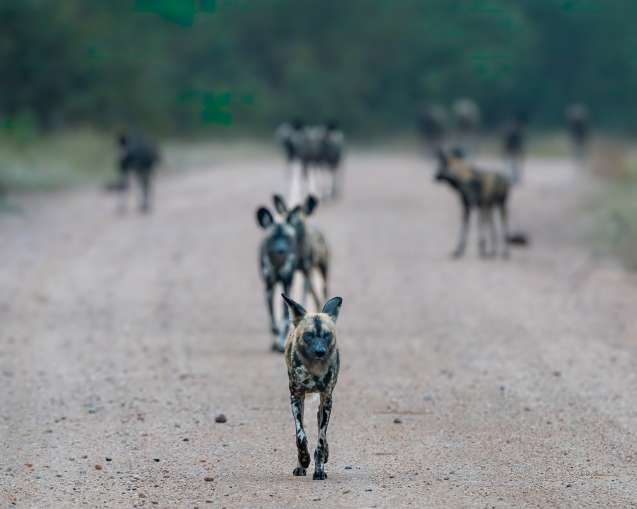
Covering over 50,000 hectares of prime game-filled savannah, Timbavati includes the Motswari Game Reserve, Ngala Game Reserve, Tanda Tula Game Reserve and Umlani Game Reserve. The area is known most famously for its white lions which, if you're lucky, you may spot amongst the plethora of wildlife that call Timbavati home.
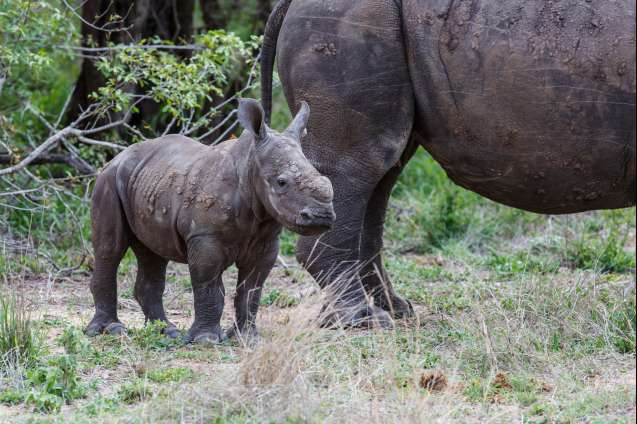
Thornybush Private Nature Reserve comprises 14,000 hectares of pristine bush located between Kapama and Timbavati in Greater Kruger National Park. It is renowned for exceptional wildlife viewing and an authentic African safari experience. Visitors can encounter the Big Five—elephant, buffalo, lion, leopard, and rhinoceros—along with diverse birdlife. Elephants are often seen drinking at waterholes visible from the lodges. The reserve offers outstanding natural beauty, guided game walks, and game drives, ensuring a memorable wildlife experience.
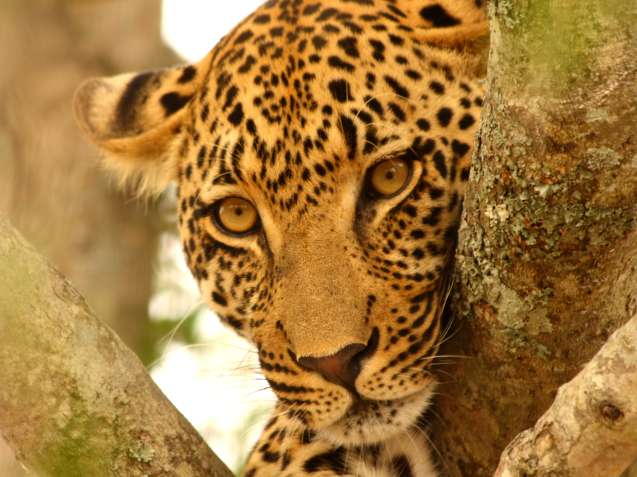
Sabi Sands incorporates the Mala Mala Reserve, Djuma Game Reserve, Lion Sands, Sabi Sabi Private Game Reserve, Londolozi Private Game Reserve, Singita Game Reserve and Ulusaba Private Game Reserve and covers 65,000 hectares. The Sabi River and Sand River run through the area providing diverse habitats for the huge range of animals. Sabi Sands Game Reserve is known especially for its big cat sightings, most notably of the elusive leopard.
For a comparison see Kruger National Park vs Sabi Sands.
Kapama Private Game Reserve comprises 13,000 hectares of sweeping wilderness. Both the Kapama River and the Klaserie River flow through the reserve, creating an area of riverine forest amidst sweeping savannah. These serve as natural water sources for the resident wildlife, of which there is a wide array!
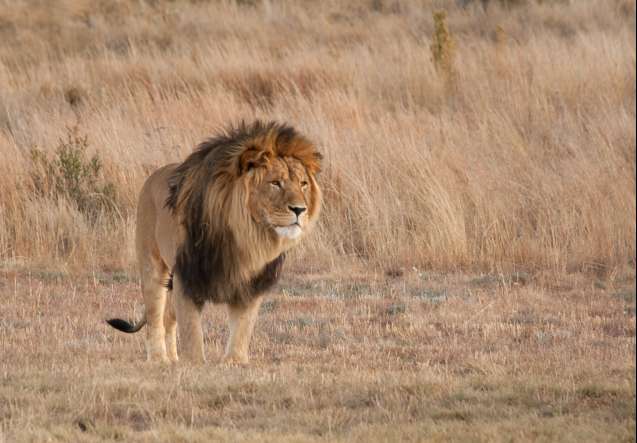
One of the largest privately owned reserves in South Africa, Klaserie covers 60,000 hectares of land along the Klaserie River. The owners are deeply committed to conservation and the park hosts three amazing projects: the Ground Hornbill Project, Rhino Protection and The Elephant Project.
The best way to get to Greater Kruger National Park is to fly to Johannesburg, the closest major city to Kruger. From Johannesburg, the most affordable option is to join one of the many overland safaris to Kruger. You can start by browsing our upcoming African safaris departing from Johannesburg, which include lots of Greater Kruger National Park safaris.
You can also fly to Kruger, or one of the minor airports closer to Kruger National Park, from Johannesburg or Cape Town to save on travel time.
Browse our Kruger National Park Safaris for fly-in tour options from Cape Town and Johannesburg in South Africa.
Our 6-day small group Kruger and private reserve safari is perfect for travelers seeking variety and intimacy. Limited to just 10 guests, this comprehensive tour explores three different private game reserves—Balule, Tshukudu, and Motlala—plus two full days in Kruger National Park. Starting and ending in Johannesburg, this lodge-based safari offers comfortable accommodation throughout while maintaining authentic bush experiences.
For an epic journey through the entire park, our 9-day Kruger North to South safari traverses over 360km from the remote northern wilderness to the wildlife-rich southern regions, staying at authentic SANParks rest camps throughout. This small group expedition (maximum 12 guests) offers an immersive Kruger experience from Johannesburg to Cape Town.
For help choosing the Greater Kruger National Park Safari that is best for you and your budget, contact one of our African travel experts.
Explore these destinations mentioned in this post.
Below you'll find further reading and articles related or similar to this post.



Call us toll free from US/Canada on 1-888-414-6513, or from the UK on 0-808-189-1052. All other countries can contact us on +27 21 791 0878.
© 2026 African Budget Safaris | Privacy | Terms | Cookie Policy | Consent Preferences