

At African Budget Safaris, we love organizing trips to the spectacular Kruger National Park. We get numerous questions from clients on all things Kruger Safari. We decided to put all the useful information to answer these questions in an easily accessible blog.
If you don't find an answer to your specific question, get hold of one of our knowledgeable travel consultants and they'll gladly help you.

The Kruger National Park is an area 65 km wide and 360 km long in northeast South Africa. It borders Mozambique to the East, and Zimbabwe on its northern tip.

Getting to Kruger National Park involves either traveling by road (self-drive or shuttle) or by air. The distances and times here are to central Kruger, Satara Camp.
If you want to hire a car to drive to Kruger, check out our car hire page for great deals.
Remember that Kruger National Park is a vast area, so distances and traveling times will differ according to which part of the park you're visiting and where you're coming from.
Getting to Kruger Park affordably is easy with our wide selection of budget Kruger National Park Safaris. To see what tour options are available on your travel dates, browse our calendar listing of Kruger safaris departing from Johannesburg.

Yes, there are several airports near Kruger National Park. There are 35 flights a week to the airports close to Kruger Park, to which local airlines (SA Express, Airlink, SAA, and BA) fly.
Airports include:
Besides these airports, there are many small airfields scattered throughout the area, to which charter planes can be organized. We can make any of the African Budget Safari trips fly-in safaris if that's what you want.

The gates/entrances into Kruger National Park have different opening and closing times during different seasons, as do the gates into the camps within the park. This is to line up with when it gets light/dark. Remember to factor in driving times from the entrance into Kruger to specific camps. Travel times from entrance gates to camp gates can be found on the SANParks site.
These times are for the gates in the Kruger National Park:
The private reserves that make up the (unfenced) Greater Kruger National Park can be contacted directly about closing times, as they often have people on duty at the gates for longer hours, thus allowing earlier/later check-ins/check-outs.

Visitors to Kruger National Park must pay a daily entrance fee or conservation fee. This ensures that the Kruger National Park can keep going. The fees below are valid until 31 October 2018, when the annual increase will come into effect:

Essentially, they're the same thing, but Greater Kruger National Park refers to a much bigger area that includes the Kruger National Park and 22 private game reserves. The area is unfenced, so the animals roam freely. For a full description of the differences, pros, and cons, please read our blog Greater Kruger National Park Explained.
We offer tours that include both. For Kruger, check out our 4-Day Kruger Park Bungalow Safari. If you want to stay in Greater Kruger National Park, look at our 4-Day Kruger Park Eco Camp Safari at Private Reserve and 4-Day Kruger Park Bush Camp Safari. Many Greater Kruger Safaris include day trips into Kruger itself, so chat with one of our consultants if you want to experience both!
See more in our safari report on Kruger vs Greater Kruger National Park.
__medium.jpg)
There are multiple types of accommodation in Kruger National Park, which is one of the (many) wonderful things about visiting the Kruger Park, and Greater Kruger National Park, in that it caters to all preferences and all budgets.
There are multiple types of accommodation in Kruger National Park, including:

Speak to one of our knowledgeable travel consultants about your preference and budget or take a look around our website – you can put your budget and accommodation preferences in our search tool on the right-hand side, to find your ideal Kruger National Park safari.
Want to sleep in a 'treehouse'? Check out our 4-Day Kruger Park Treehouse & Private Game Lodge Safari. Is camping more your style? Have a look at the Kruger & Sabi Sands Tented Camp Package.

Yes, there are shops and restaurants in Kruger National Park. The bigger campsites within Kruger Park do have basic shops, restaurants and petrol stations. There are only ATMs at Skukuza and Letaba. Smaller camps that are all-inclusive may provide drinks and snacks for sale, and occasionally some curios, but most don't have ATMs, so remember to take cash with you for incidentals or be willing to pay with your debit or credit cards.

Mostly, there is no wi-fi or mobile/cell reception in Kruger National Park and Greater Kruger National Park. Mobile/cell reception is generally okay in the camps, but in the park itself, it is sketchy. Enjoy the bush and turn your mobile off! Some of the camps, especially the private ones, have Wi-Fi – usually only in the main reception areas. If this is a priority for you, check which camps are included in your safari and check with each camp.
If we were you, though, we'd use our Kruger National Park safari as a good reason to take a complete break from technology!
__medium.jpg)
Game drives in Kruger are generally in the early morning, or late afternoon/evening, as this is when the animals are active. During the heat of the middle of the day, everyone rests, human and animal! If you're on a full-day game drive, you'll more often than not stop for a lunch break at one of the camps, at midday.
Again, the starting times depend on the season. Morning drives usually start about an hour before the official gate opening times, so you get the whole of Kruger to yourselves, while the sun rises. Sunset drives leave camp just before dusk.
In some of the parks within the Greater Kruger National Park region, drives can be organized to suit a specific group – both the length and the starting time. This is usually possible if you book an entire camp i.e. eight people or more.

Guided walks are usually in the early morning, setting out when it gets light, or late afternoon and are always accompanied by armed rangers. Note that under-12s are not allowed on guided walks.

Both morning and late afternoon game drives in the Kruger usually last about three to three-and-a-half hours. Likewise, guided walks usually last about three hours. A full-day drive can last from early morning until gate closing time, with a break in the middle for lunch.
Kruger Park night drives are slightly shorter, at around two hours, and depart at either 19:30 or 20:00, depending on the season.
Within Kruger National Park, game drives can cost between R250 and R500, and guided walks between R500 and R750. For many of the trips offered by African Budget Safaris, drives and walks are included in the safari price.
Find out more about Kruger Safari Costs.
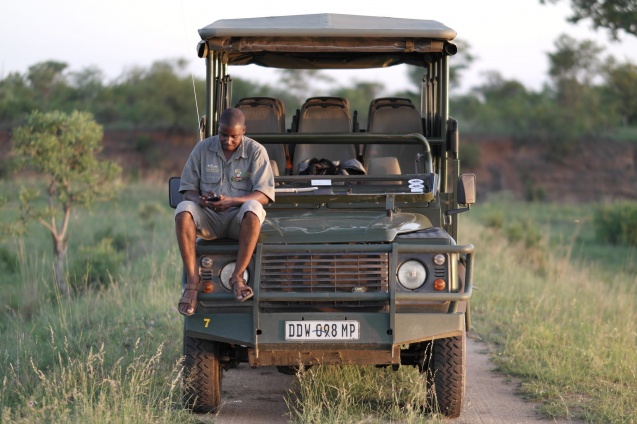
Most game drives on Kruger National Park safaris are done in open-sided safari vehicles (with a canopy/roof), with stepped seating, to allow the best views for everybody. Remember, though that they are open, therefore you'll get the full effect of whatever the weather is. The weather can also change quickly, so pack for all seasons – it can be very hot during the day, especially in summer, and nippy in the early morning/at night. (see Kruger packing list below).
The weather in Kruger National Park differs from one area to the next. This graph shows the annual temperature and rainfall for Skukuza.

Remember that the rainy season is summer – October to March – which means that the bush is lush and green, making game viewing a little more challenging. The 'rainy' season usually consists of beautiful, hot mornings with wild and short thunderstorms in the afternoons, followed by more sunshine.
See when to visit Kruger National Park in South Africa for more details.

Packing for your Kruger National Park safari is a seasonal affair, but even in summer, pack something warm for cool early mornings and evenings, and in winter, something cool for warm days. Avoid bright colours.
See our complete Safari Packing List for more details about what to pack for safaris.
Yes, Kruger National Park is a malaria-risk area, so you need to take malaria prophylaxis. For everything to do with malaria, check out our blog, Malaria Made Simple.
In the case of a medical emergency in Kruger National Park, tell your tour leader immediately, and they will make the necessary arrangements. This is why getting travel insurance – including medical insurance – is compulsory when booking a trip through African Budget Safaris.
While there is a small doctor's practice within the camp at Skukuza that can deal with minor ailments and doctors and hospitals in the towns outside the Kruger Park, distances can be big. With medical insurance, plans can be made quickly, should an emergency occur.
Yes, the Kruger National Park is safe as long as you stick to the rules of the bush, so have a read of all the do's and don'ts in our blog, Safety on Safari.

Yes, Kruger National Park is a great place to take children. Some camps even provide child-friendly activities. While options like guided walks and some game drives have age restrictions, some camps are specifically geared toward families with children. Compare family-friendly Kruger National Park safaris on our Family Safaris in Southern Africa page.
Ask one of our ABS travel consultants to steer you in the right direction.

Yes, there is water in Kruger National Park. While it is always a water-scarce area, as is most of Africa, and may experience drought in some years, it has a good infrastructure and water is available throughout the park.
Yes, in many places the Kruger National Park is wheelchair-friendly, and no, in others. The main camps all have chalets that are universally accessible, and most public areas in the camps are also wheelchair-friendly. Game drives can be tricky with transferring into the vehicles, but people are friendly and helpful and plans can be made.
Getting to Kruger National Park on a budget is simple and easy with our budget Kruger National Park Safaris. If you still have unanswered questions, simply ask one of our African travel experts.
Explore these destinations mentioned in this post.
Below you'll find further reading and articles related or similar to this post.




Call us toll free from US/Canada on 1-888-414-6513, or from the UK on 0-808-189-1052. All other countries can contact us on +27 21 791 0878.
© 2026 African Budget Safaris | Privacy | Terms | Cookie Policy | Consent Preferences








__large.jpg)

